Building the Mixer’s Stage
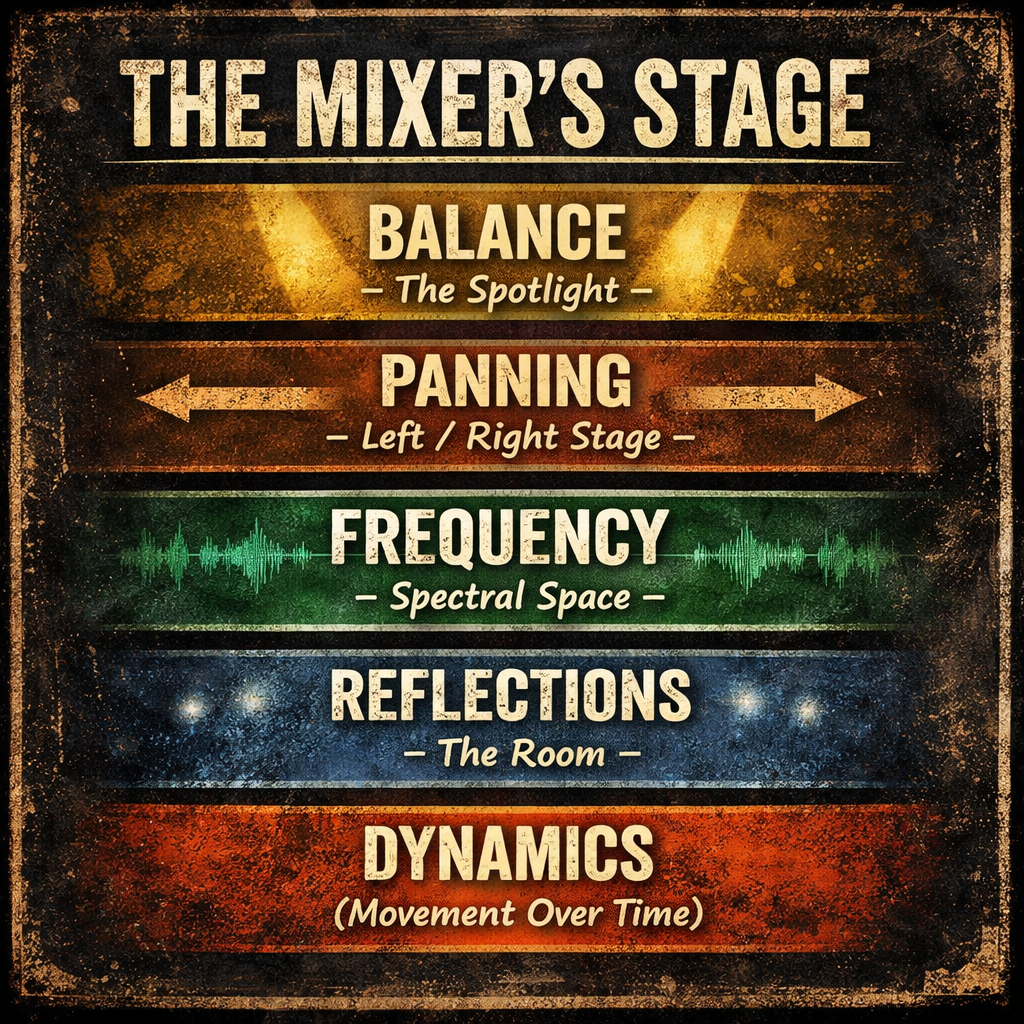 When you build a mix, you’re really building a stage.
The band may have recorded their parts separately — track by track, microphone by microphone — but the listener never experiences those isolated pieces.
They hear something very different.
They hear a performance happening in front of them.
A singer standing in the spotlight.
Guitars stretching across the speakers.
A rhythm section anchoring the center.
A space surrounding the entire band.
None of that happens automatically.
A mix only begins to feel like a performance when the mixer constructs that stage deliberately.
And like any stage, that space isn’t random.
It’s shaped by a handful of elements that determine what the listener notices, where the musicians appear, and how the music moves.
A mix becomes clear when it is built in layers.
First decide what the listener should focus on.
Then decide where the musicians stand across the stage.
Then give each instrument its own frequency space.
Then place the band inside an environment.
Finally, shape how the performance evolves over time.
Trying to solve all of these things at once usually leads to confusion.
But when the stage is built one layer at a time, the picture gradually comes into focus.
The mix stops feeling like a collection of tracks.
And it starts to feel like a performance.
1. Balance — Setting the Spotlight
Every mix begins with balance.
Before EQ, before compression, before reverb, the mixer decides one simple thing:
What should the listener notice first?
Volume determines importance.
The loudest elements feel closest to the listener, while quieter sounds naturally fall further back in the picture.
A vocal pushed clearly above the band becomes the focal point of the song.
A guitar sitting slightly lower supports the music without competing for attention.
Many experienced mixers build their entire rough mix using nothing but faders.
Because balance doesn’t just control loudness.
It establishes the hierarchy of the performance.
2. Panning — Placing the Musicians
Once the spotlight is set, the next question becomes:
Where are the musicians standing on the stage?
Panning spreads the band across the stereo field.
The vocal and snare often anchor the center.
Guitars stretch toward the sides.
Keyboards, percussion, and textures fill the spaces in between.
Just like a real stage, musicians don’t all stand in the same place.
Panning gives each instrument its own position in the performance.
In practice, balance and panning are often established together during the rough mix.
The faders determine importance.
Panning determines position.
Balance decides who the audience notices.
Panning decides where those musicians stand.
3. Frequency — Giving Each Instrument Its Space
Even when instruments are balanced and panned well, they can still collide in the frequency spectrum.
This is where EQ becomes important.
Frequency shaping creates spectral space.
Kick and bass occupy the low end.
Guitars and vocals dominate the midrange.
Cymbals and air live in the top.
When too many instruments compete for the same frequency range, the mix becomes muddy and crowded.
The solution isn’t boosting everything louder.
It’s making room.
Often the best EQ move isn’t adding something.
It’s removing something that doesn’t belong.
When each instrument occupies its own region of the spectrum, the mix opens up naturally.
4. Reflections — Creating the Room
So far we’ve placed the band on the stage.
Now we decide what kind of room they’re performing in.
Reflections — reverb, ambience, and delay — provide environmental cues that tell the brain how large the space feels.
A dry vocal feels intimate and immediate.
A vocal surrounded by reflections feels like it exists inside a larger environment.
These reflections help the listener imagine the physical space around the band.
Used carefully, they add dimension and atmosphere.
Used excessively, they blur the picture.
The goal is not simply adding reverb.
The goal is creating a believable environment for the performance.
5. Dynamics — Bringing the Performance to Life
The final element is movement.
Music unfolds over time.
A verse might feel restrained and intimate.
A chorus explodes with energy.
A breakdown pulls the listener close before the final impact.
Compression, automation, and arrangement all shape this sense of motion.
Without dynamics, a mix becomes static.
With them, the performance breathes.
The music doesn’t simply occupy space.
It moves through it.