How to EQ a Snare Drum
 There is a moment in every mix when the snare tells you the truth.
If the snare works, the entire record suddenly feels alive.
If the snare doesn’t work, nothing else quite locks in.
You can have massive guitars, a thunderous kick drum, and a wall of vocals — but if the snare is weak, the record never feels finished.
That’s why learning to EQ a snare properly is one of the most important skills a rock mixer can develop.
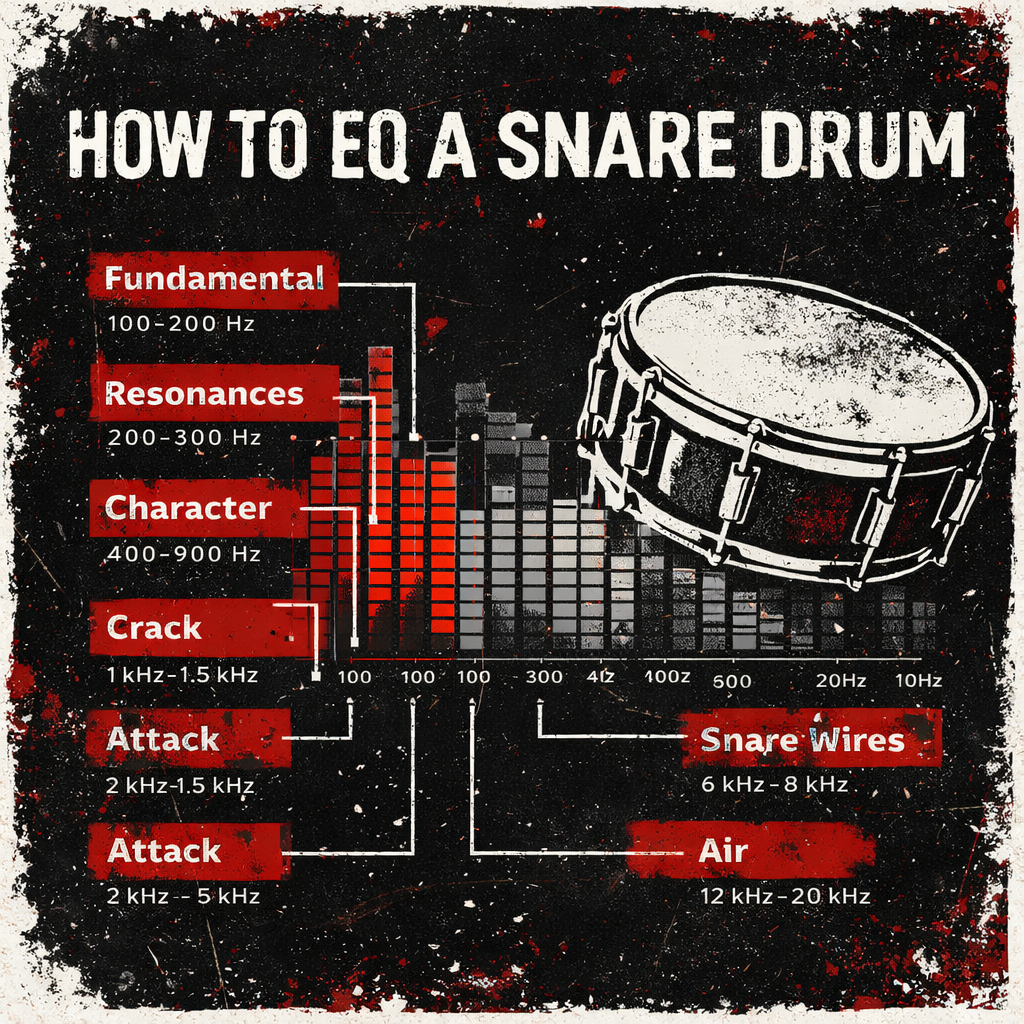
A useful framework for understanding snare EQ comes from the approach taught by Kohle from Kohle Audio Kult. His method breaks the snare sound into clear frequency zones so you can understand what each part of the spectrum contributes to the sound.
Level Matching
Whenever you EQ something, you are also changing its loudness.
Boosting frequencies makes the signal louder. Cutting frequencies makes it quieter.
The problem is that our brains almost always prefer the louder sound.
So when an EQ move sounds “better,” you might actually just be hearing the increase in volume.
The solution is simple.
After making an EQ adjustment, match the output level so the signal is the same volume before and after EQ.
Only then can you judge whether the EQ move actually improved the sound.
100 Hz – 200 Hz
The Snare’s Fundamental
This is where the snare drum’s body and punch live.
Most snares have their fundamental frequency somewhere in this range.
If your snare feels thin or weak, a small boost here can add weight and authority.
At the same time, it can help to remove unnecessary sub-frequencies below the fundamental so the snare leaves space for kick and bass in the mix.
200 Hz – 300 Hz
Resonances
Just above the fundamental you will often find unwanted resonances.
These frequencies can make the snare sound muddy or uncontrolled.
The usual solution is narrow, surgical cuts.
Small reductions in this range can clean up the drum and make it feel tighter and more focused.
400 Hz – 900 Hz
Wood and Character
This region gives the snare its woody tone and personality.
Boosting here emphasizes the natural ring and vibe of the drum.
Cutting here creates a cleaner, more modern sound.
1 kHz – 1.5 kHz
The Crack
This frequency range helps the snare cut through a dense mix.
A small boost here adds bite without making the snare overly bright.
2 kHz – 5 kHz
Attack
This range defines the stick impact.
Boosting here increases snap and clarity.
Too much, however, can make the snare harsh.
6 kHz – 8 kHz
Snare Wires
This range emphasizes the sound of the snare wires.
It can add excitement, but it can also exaggerate cymbal bleed.
12 kHz – 20 kHz
Ultra High End
At the very top of the spectrum lies the ultra-high end.
In some mixes engineers even apply a gentle low-pass filter here so cymbals have more space in the overall balance.
What We Are Actually Looking For
At the end of the day, a great snare only needs two things.
Attack.
And punch.
Everything else is simply shaping the tone so those two qualities translate through the mix.
A great snare doesn’t just sound good in solo.
It drives the groove of the entire record.