Mixing with Depth
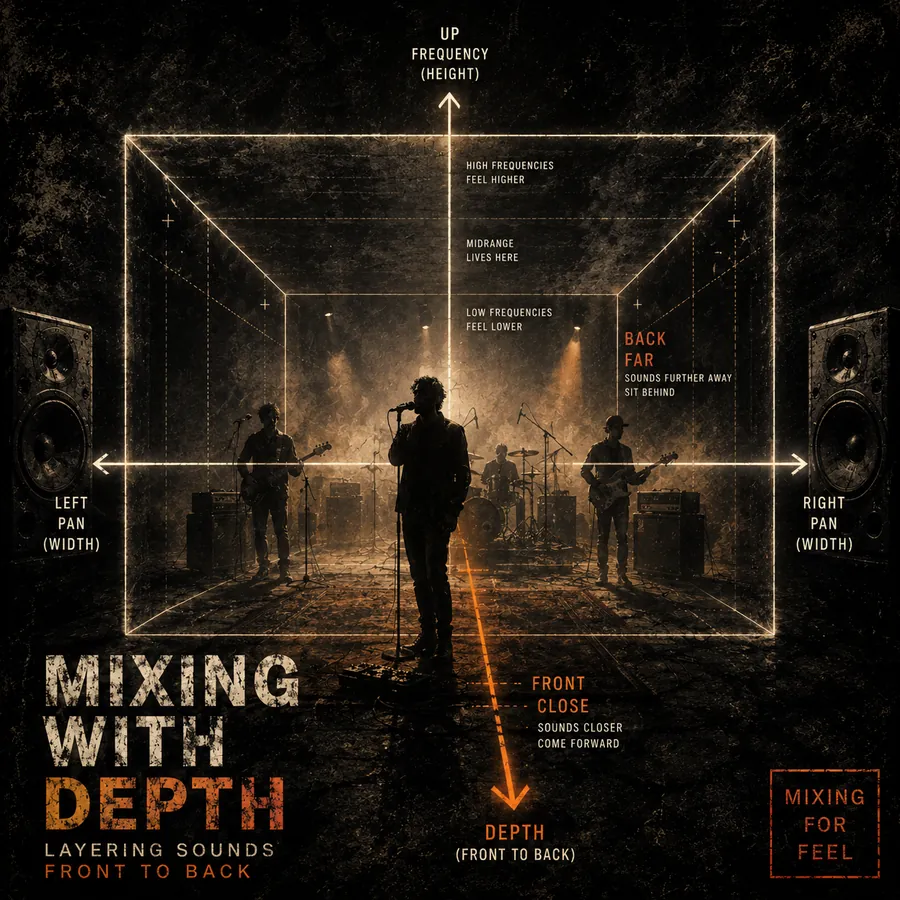 Some mixes feel flat.
Others feel three-dimensional.
Not just wide…
three-dimensional.
You can hear sounds:
- left and right
- high and low
- in front of and behind each other
And when all three begin working together, the mix stops sounding like speakers.
It starts feeling physical.
The Three Dimensions of a Mix
When we listen to music through speakers or headphones, our brain still tries to organize the sound spatially.
Not as tracks.
As a space.
That space has three dimensions:
- left to right
- up and down
- front to back
Left to Right
This is width.
Panning spreads sounds across the stereo field.
Vocals, kick, snare, and bass often anchor the center while guitars, keyboards, percussion, and effects spread outward.
This is the most obvious spatial effect in mixing because stereo playback physically separates the speakers themselves.
Even non-engineers hear width immediately.
Up and Down
This is height.
Height comes from frequency.
Low frequencies feel lower.
High frequencies feel higher.
Kick drums and bass guitars anchor the bottom of the mix.
Vocals, guitars, and snare drums tend to occupy the middle.
Cymbals, air, and upper harmonics rise toward the top.
When frequencies are separated clearly, the mix opens vertically.
This is one reason EQ is so powerful.
Frequency separation can help create clarity and dimension…
but complete separation is not always the goal.
Some of the most exciting mixes are built from controlled overlap.
Dimension comes from relationships.
Not isolated slots.
Front to Back
This is depth.
Some sounds feel close.
Others feel further behind them.
They’re layered front to back.
And that front-to-back layering is what completes the illusion of three-dimensional sound.
Without depth, even a wide mix can still feel flat.
Everything exists on the same plane.
Nothing leads.
Nothing supports.
Nothing recedes.
The mix becomes crowded because every sound feels equally forward.
Why Depth Is Harder to Understand
Width is easy to hear.
Height is fairly intuitive once you think about frequency.
Depth is harder because there is no physical front-to-back axis between speakers.
Nothing is actually moving closer or further away.
The illusion happens entirely in the listener’s perception.
And unlike width or height, depth is not controlled by one thing.
It emerges from several different cues working together.
Level Creates Position
One of the strongest depth cues is level.
Louder sounds tend to feel more forward.
Quieter sounds tend to feel further back.
This is why experienced mixers can often create depth during the rough mix before touching plugins at all.
The faders already begin establishing perspective.
A lead vocal slightly above the band naturally feels forward.
Supporting instruments slightly underneath begin sitting behind it.
This relationship is one reason balance matters so much.
Without contrast, there is no perspective.
If everything feels equally loud, everything competes for the same front position.
Frequency Affects Distance
Tone also affects depth perception.
Brighter sounds usually feel closer.
Darker sounds usually feel further away.
High-frequency detail creates immediacy and presence.
Reduce that detail and sounds begin slipping backward into the mix.
This is one reason harsh mixes often feel exhausting.
Everything is fighting to occupy the front.
Nothing relaxes into the background.
Great mixes usually contain contrast between forward and recessed elements.
Reverb Does Not Create Depth
This is one of the biggest misconceptions in mixing.
Reverb alone does not create depth.
In fact, too much reverb often destroys it.
Reverb creates reflections and ambience cues that the brain interprets as space.
But those cues only work properly when level and tone support them.
A loud, bright vocal with huge reverb can still feel extremely forward.
Meanwhile a dry but dark and quiet instrument can still feel distant.
Depth comes from relationships between cues.
Not from one plugin.
Why Some Mixes Feel Expensive
One reason expensive mixes often sound bigger is because they contain stronger front-to-back layering.
Not everything fights for the same position.
The vocal leads.
The snare punches through.
The supporting instruments sit slightly behind.
Effects stretch further back into the space.
The listener experiences perspective.
And perspective creates immersion.
Low End and Physicality
Low frequencies behave differently from everything else in a mix.
They don’t localize clearly left and right the way high frequencies do.
Instead, they create weight and physicality.
Too little low end and a mix can feel thin and flat even when the width and balance are good.
Too much and the depth begins collapsing into mud.
The low end stops supporting the image and starts obscuring it.
Good low-end mixing is not just about punch.
It is about maintaining dimensional clarity while preserving weight.
Without weight, the image loses gravity.
Depth Starts Earlier Than Reverb
Many mixers try adding depth near the end of the process through ambience plugins.
But depth often starts much earlier:
- arrangement
- balance
- tone selection
- contrast
- performance dynamics
Some recordings already feel deep before any processing happens because the relationships are naturally working.
Others fight depth from the beginning because too many elements occupy the same emotional and spectral position.
Mixing Is the Art of Perspective
A mix is not just a collection of sounds.
It is the organization of attention.
What sits forward?
What supports?
What stays behind?
What surrounds the listener?
The best mixers are not simply balancing instruments.
They are shaping perspective.
And once sounds begin layering front to back…
the mix stops feeling flat.
It starts feeling alive.